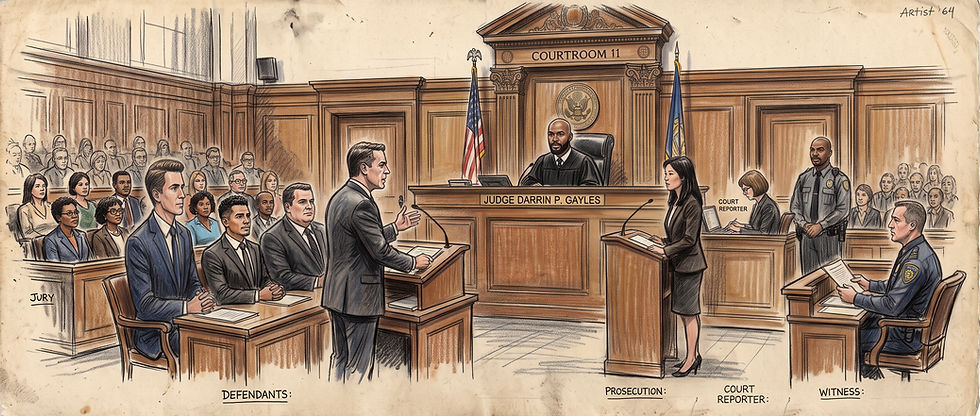
Public record: rulings and coverage
BEDROCK PRINCIPLES OFFENDED
“The Government’s actions offend bedrock principles of the American criminal justice system”
— Judge Darrin P. Gayles, U.S. District Court
GOVERNMENT LIED TO THE COURT
“Shockingly, throughout the entirety of the pretrial proceedings, the Government lied to the Court….”
— Judge Darrin P. Gayles, U.S. District Court, Southern District of Florida
PROSECUTORS LIED
“Prosecutors shouldn’t be able to cheat…”
— Jay Weaver, Miami Herald
UNCONSTITUTIONAL CONDUCT
“...it was unquestionably unconstitutional.”
— Judge Darrin P. Gayles, U.S. District Court
CONVICTIONS TOSSED AFTER MISCONDUCT
“The Court hereby vacates the convictions and sentences of Defendants Matthew Pisoni…” — Judge Darrin P. Gayles, U.S. District Court, Southern District of Florida
YEARS OF LITIGATION AFTER MISCONDUCT
-
“We uncovered massive misconduct, leading to years of litigation”
—David Markus Markus/Moss PLLC
PROSECUTORS LIED TO THE COURT
“‘But the most egregious thing is, [the prosecutors] lied to the court about it,’ the judge said.”
— Jay Weaver, Miami Herald
Spying & Lying Alleged
“Federal judge blasts Miami prosecutors for spying… and then lying to the court to cover up misconduct”
— NBC 6 South Florida
SIXTH AMENDMENT VIOLATED
“In an excoriating ruling… Judge Darrin Gayles said Assistant U.S. Attorney(s) violated the Sixth Amendment [rights]…”
— Associated Press
⚡ BREAKING: COURT WILL NOT TOLERATE DECEPTION
“The Court will not tolerate willful violations of the Defendants’ constitutional rights or deception by officers of the court”
— Associated Press, via NBC 6 South Florida
DOJ KNEW OF SPYING
“Sealed documents…by the Department of Justice show prosecutors not only knew about…spying, but also instructed him to gather information”
— Associated Press, via NBC 6 South Florida
PATTERN OF DISREGARDING RIGHTS
“This is at least the third time in recent years that defense attorneys have caught federal prosecutors in Miami ‘flagrantly disregarding’ defendants’ constitutional rights.”
— Ricardo Bascuas, University of Miami law professor
DELIBERATELY MISLED THE COURT
“Federal prosecutors ‘deliberately misled’ court”
— ABA Journal
DIRTY DEALINGS GONE TOO FAR
“A federal judge decided that the dirty dealings of the prosecutors had gone too far” — Ratzan & Faccidomo
ESPECIALLY EGREGIOUS CONDUCT
“Prosecutors’ conduct was especially egregious”
— Ratzan & Faccidomo
KNOWING PROSECUTORIAL MISCONDUCT
“Department of Justice (‘DOJ’) attorneys knowingly engaged in prosecutorial misconduct…deliberately misleading the Court...”
SYSTEMIC PROBLEM FOR JUSTICE SYSTEM
“Such conduct by federal prosecutors … is highly problematic for the entire criminal justice system...”
— Arnall Golden Gregory LLP
Case timeline
Chronological record of the federal criminal case and the related FTC civil matter.
2012
March — Case was opened and investigations started.
2014
Through the year — Federal investigation of the enterprise develops.
2015
Mid-year — Indictment filed. Multiple defendants named. All defendants secure separate counsel and reaffirm a joint defense agreement.
Late in the year — Court holds a hearing on the “advice of counsel” defense. Judge rules verbally that the defense may be used if prior reliance is established.
December — Original trial date; case is rescheduled to March 2016.
2016
February 17 — A co-defendant secretly enters into a cooperation agreement with the government and provides prosecutors with defense case-preparation materials. He continues to participate in joint defense meetings while cooperating.
April 20 — Cooperation is revealed at a change-of-plea hearing.
August 3 — Defense files a motion to dismiss based on invasion of the attorney-client privilege; the defense establishes that the government had received the defense materials.
October–November — Court conducts hearings on the misconduct. Judge finds misconduct was extensive, excludes the cooperating co-defendant from trial, but denies the motion to dismiss. Trial rescheduled to May 2017.
2017
April — Government rejects the defense request to remove the prosecution team. Judge denies the defense motion to reconsider.
June 19–27 — Jury selection. Defense objects to statements made to the jury pool before voir dire.
June 28 — Opening arguments.
June 28 – July 13 — Government's case-in-chief.
July 19 — Defense rests.
July 20 – July 24 — Government rebuttal.
July 25 — Closing arguments conclude.
July 26 — Jury returns verdicts: acquittal on all fraud counts ; conviction on a single count.
October — DOJ Office of Professional Responsibility (OPR) opens an investigation into the government's conduct in the case.
November 28 — Sentencing hearing. The court rejects the government's sentencing enhancements, including the government's “elderly victims” enhancement, finding no evidence the defendants targeted elderly persons.
2018
January 9 — Government files a notice to correct the record, acknowledging that prior representations to the court were incorrect and that the government did obtain and possess documents it had previously stated it did not possess.
January 11 — Court stays the surrender date.
March 8 — Surrender date extended.
June (approx.) — Court grants full bond pending appeal and stays surrender.
October 12 — Defense files a motion for in camera review of OPR records.
2019
February — Judge orders the government to unseal previously sealed misconduct materials filed in open court.
November 21 — Reviewing magistrate issues order authorizing defense discovery of OPR documents.
2020
February 28 — Defense files joint motion for new trial.
December 3 — Hearing on the new-trial motion.
2021
July 16 — At a status conference, the court verbally announces it will grant a new trial and set aside the judgments.
2022
November 18 — Court issues written order granting new trial and vacating the convictions and sentences.
2023
February 16 — Court restricts the government to evidence available to it before the compromised cooperation began in February 2016, finding no prejudice to the government in proceeding to trial on the original evidentiary record.
March 20 — DOJ Professional Misconduct Review Unit issues findings against one of the prosecutors, imposing a 14-day unpaid suspension and referring the matter to the state bar.
April 19 — Court hearing at which the court questions the wisdom of proceeding to a retrial. New trial date set for January 2024.
July 28 — Government initiates plea discussions. Defense rejects the government's initial offers.
September 11 — Non-plea deferred prosecution agreement reached.
2024
January 26 — Change-of-plea hearing for the remaining defendants.
February 26 — Hearing: no incarceration, three years' probation, and a $100 court fee for each defendant.
February 28 — Deferred-prosecution agreement filed and approved.
2025
March 3 — Indictment against defendant is dismissed following completion of the deferred-prosecution terms and 100 hours of community service.
December 9 — State bar files a formal complaint for sanctions against one of the prosecutors.
2026
February 26 — State bar files a formal complaint against the second prosecutor. The two matters are consolidated by court order.
April 27 — Initial hearing scheduled before the bar arbiter. Recommendations to the state Supreme Court expected within six months.
Related FTC civil matter
The Federal Trade Commission brought a separate civil action arising from the same underlying sweepstakes activity that was the subject of the criminal case. It was filed in the U.S. District Court for the Southern District of Florida (FTC v. Mail Tree Inc., et al., Case No. 15-61034-CIV) and resolved by stipulated order without any admission of liability or any finding by the court.
2015
Filed — FTC files a civil complaint under Section 13(b) of the FTC Act relating to prize-promotion practices.
2024
June 21 — Court enters stipulated orders for injunction. Under the terms, each individual is restrained from prize promotion marketing. The orders are entered by consent, without any admission of liability and without any monetary judgment.
August — Court enters a separate stipulated order as to an additional individual defendant on comparable terms.
Related Articles


